


“The Adventures of a Girl” is one part diary and two parts memory book. The young author’s memories provide glimpses of her rambling childhood in 1950s America. The entries reflect her optimism and resilience as she navigates through the changes in life. Chapter FIVE is posted here in its lightly edited form. To read more, go to “The Adventures of a Girl.”
FIVE: 1950s, Oklahoma
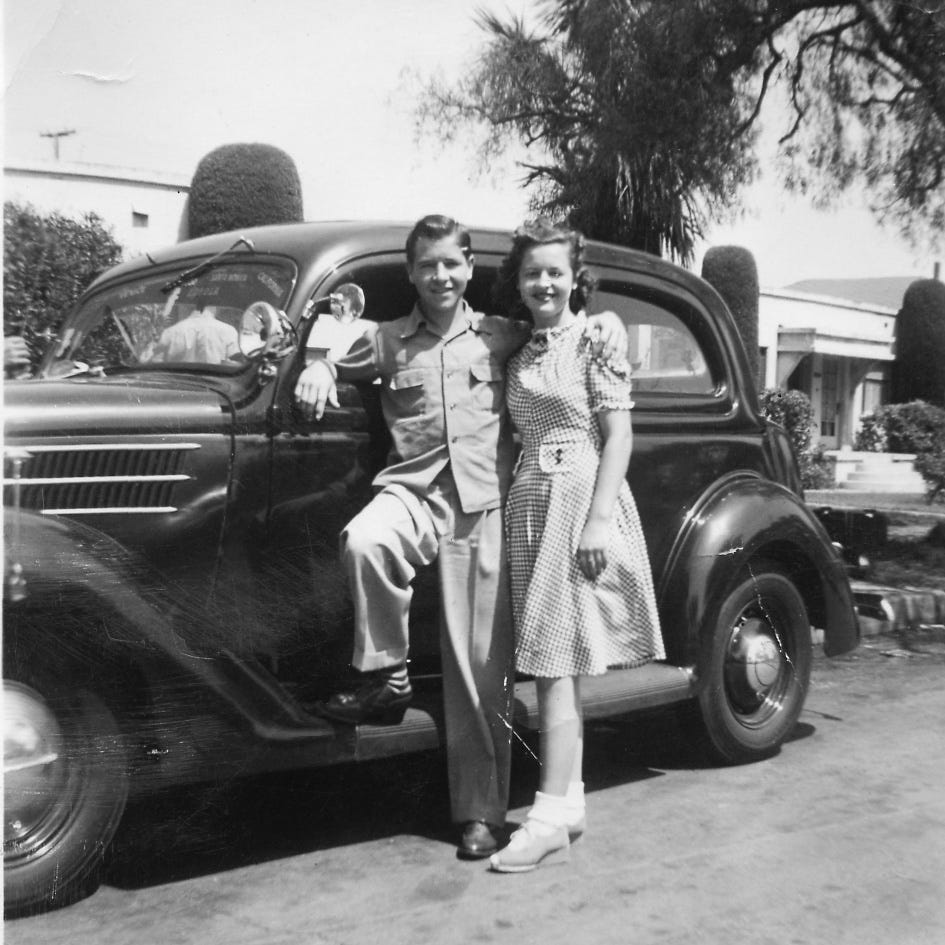
The men in our family—soldier and sailor alike—returned to Oklahoma as restless as cats. By the time the war was over, my father and uncles were still in their twenties and eager to pick up where they left off. The younger ones who were teenagers when they left, hadn’t started their lives in the first place. Not a one, however, was certain about his future, he just knew it had to be something different.
My father and his two brothers had not a minute’s interest in returning to the family farm outside Oklahoma City. Instead, the three went in together to form the Marvel Brothers Painting Co. hoping to ride the postwar construction boom. With that decision, my grandparents put the farm up for sale and moved into town. When the farm sold in 1947, they auctioned off everything that was left including 32 Holstein cows, all the dairy equipment, 85 hens and a Wagner upright piano. (Sunny Lane United Methodist Church now sits on land that until the 1980s was the original Marvel farm.)

At first, most of mother’s family settled back in Oklahoma City, living within a mile of each other in a subdivision of new brick homes. Aunt Lois and Uncle Harvey lived on the corner across from our house. Aunt Lois, mother’s oldest sister, had been a “flapper” in the 1920s and lived up to her billing as the family’s free-thinking eccentric. Uncle Harvey, a retired Navy man, was fairly new to the family. He was lanky and frightfully tall. The scabs and scars on his bald head were earned from a lifetime of banging into things. Although he was from Yazoo City, Mississippi, he possessed not a trace of Southern charm. He didn’t talk much, and what he said required explanation. He would say things like “I’ll carry you home” by which he meant he’d “drive” us home in his battleship of a Studebaker.
Uncle Harvey fascinated us, not because he was tall, or sounded scary, but because he was a war hero. He was never was one to say much, so telling his story fell to Aunt Lois. Over the years the story would be told again and again to knots of wide-eyed children but never in Uncle Harvey’s presence.
During World War II, Uncle Harvey was a navy gunner on a battleship in the Pacific Theater. According to my aunt, Uncle Harvey had not one but two ships “Shot right out from under him.” But when the second ship went down, he and his shipmates crowded into a life raft. Here Aunt Lois would pause, then continue the story of how Uncle Harvey had survived on the open sea. Living on rations and rainwater, he fended off blood-thirsty sharks circling his raft. By the time he was rescued two weeks later, he was the raft’s lone survivor.
While the details bear additional research, the story is true. It is true that in the last years of the war, torpedoes launched from Japanese submarines destroyed more than a hundred ships, including heavy U.S. Naval cruisers and cargo ships carrying supplies to Allied forces in the Pacific. It is true that my own father also had served in the Navy, ferrying supplies from the island of Saipan to American destroyers in the Pacific. It is a fact that in 1944 when the Japanese torpedoed the USS Indianapolis, 900 sailors were thrown into the sea where 150 of those men would die in the worst shark attack in history. News of their gruesome deaths spread not only to other sailors at sea, but to their families back home. Uncle Harvey’s war story is the one we remembered due surely to the terrifying image of man-eating sharks attacking the poor sailors.

Almost as important as my uncle’s war record was the fact that our aunt and uncle owned a television set, a clunky piece of furniture as prized as a grand piano. On Saturday mornings my sister Gayle and I would be ushered across the street in time to watch “Lash LaRue” on their black and white television. Uncle Harvey would meet us at the door, hold open the screen and with a “Come in he-ah,” wave us in. We’d duck under his long arm and run to sit cross-legged in front of the tv.
Mother’s family was not only full of stories, they also had a supply of secrets at the ready when the occasion called for gossip, or a bit of revenge. For instance, Uncle Bernis had come back from the war cranky from falling out of a jeep onto his head. He lived on the next block with his wife and step-daughter. (Aunt Lois had fixed him up with her widowed friend.) It was rumored that the daughter from her first marriage was Oral Roberts’ love child. Even as kids we were fascinated by the scandal. We knew of the famous evangelist, we just weren’t sure what “love child” meant.
Then there was Uncle Jimmy, mother’s brother who was closest in age. His marriage hadn’t survived the war, which was whispered to be the reason for his drinking, a high crime in our Baptist family. Unlike our dour uncle with a head injury, Uncle Jimmy’s saving grace was his charm. The family adored him, and blamed his condition on a broken heart. In another match-making turn, just before he joined the army, Uncle Jimmy had married Gerona Marvel, our mother’s best friend. In turn mother married Aunt Gerona’s brother Grady Marvel. Subsequently when my aunt and uncle had their son, he became our double cousin, which meant we shared grandparents on both sides of the family. Also, because we were each six months apart, Larry was like a brother, a charmer himself and the instigator of a lifetime of adventures.
Before any of that, however, in the early 1940s, Uncle Jimmy had quit high school in Oklahoma and landed a job at Douglas Aircraft Co. in Santa Monica, California. From 1942 to 1945 the company produced almost 30,000 aircraft for the war effort. While he was there, mother rode the bus from Oklahoma City to Santa Monica to visit during a high school break. Both of them fell in love with California—for Uncle Jimmy, it was opportunity, for his teenage sister, it was sunshine and flowers. But the war was on. Uncle Jimmy was drafted into the Army Air Corps, and mother went home to Oklahoma. California would have to wait.
Great family history from the best historian in the family!
Dear sister it is so wonderful to step back in time when reading your memoirs. I’ve always wondered why all us cousins loved and feared Uncle Harvey. Probably because he was so tall and the men in our family were not. Thank you for another sweet memory.