


“The Adventures of a Girl” is one part diary and two parts memory book. The young author’s memories provide glimpses of her rambling childhood in 1950s America. The entries reflect her optimism and resilience as she navigates through the changes in life. CHAPTER SIX: Part 2 is posted here in its lightly edited form. To read more, go to “The Adventures of a Girl.”
SIX: Part 2, 1950s, Topanga Canyon, California
While life didn’t make sense at the time, it didn’t matter to me. For the first time, I felt like I could breathe, leave the confusion and worry of Oklahoma behind. Gayle and I considered ours the carefree life of adventurers—but one securely tethered to the apron strings of our grandmother. Big Mama also let us believe we had the run of the place and the freedom to come and go where and when pleased. Time to be a kid.
The Bee Man Appears
On one of our first expeditions, we were startled by the sight of a rumpled man trudging toward us, his head down and lost in thought. He was neither old nor young and had a knapsack slung across his chest, like Johnny Appleseed, but without the whistling. He was the Bee Man, a local fixture who could be seen walking the streets nearly every day, heading nowhere in particular. Although we had heard of the Bee Man, this was our first encounter with him. As soon as we saw him, we inched to the side of the road where we huddled together like frozen popsicles. We stood perfectly still, hardly breathing as he passed by. From the stories we’d heard, sometimes a swarm of bees trailed behind him. Alas, we didn’t see any bees that day. He walked on by seeming not to notice us; we pretended to do the same. But we had seen the Bee Man, and we were not afraid.

Life Lines and Love Lines
A fortune teller lived across from us in a cabin that, from the looks of it, was one of the oldest in the canyon. Somehow, my youngest aunt always seemed to know everyone and had already met the fortune teller. Officially, the woman was a palm reader, and like a fortune teller, was part of the world of mystics. One day, my aunt invited me to go with her, excitedly announcing that we both would have our palms read. (From the time I could talk, I had called her “my” Mae, instead of her given name, Lina Mae.) When the day came for our reading, we crossed the street and knocked on the cabin’s heavy door. When the palmist invited us inside, I was disappointed to see that she was an ordinary old lady in a wrinkled dress and a baggy sweater. Inside, the darkened living room was crowded with furniture, an overstuffed velvet couch, and several high-back chairs around an immense dining room table. Mymae and I sat on the couch next to each other. After a brief exchange with my aunt, the palmist was ready to begin.
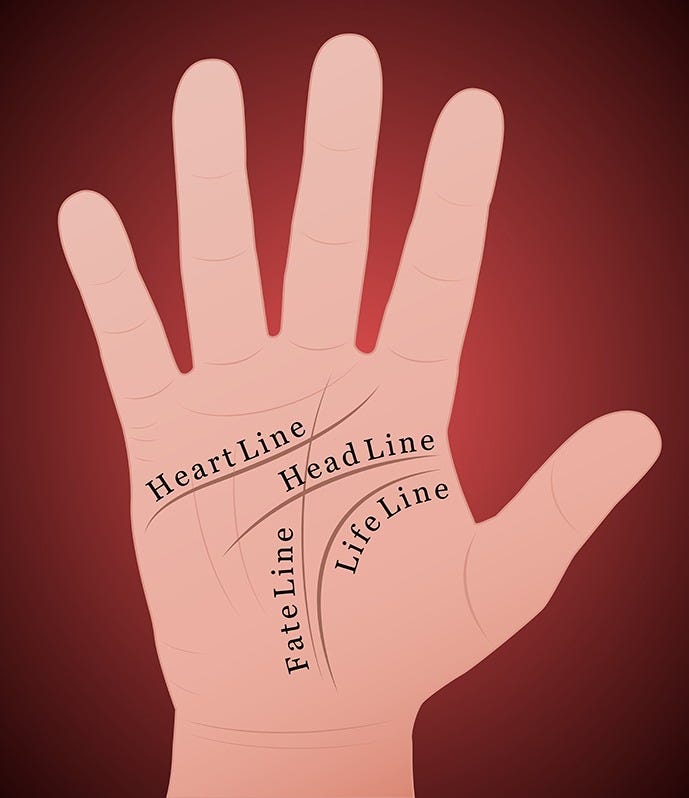
Mymae motioned for me to go first. The palmist dragged two heavy dining room chairs over to a little round table draped with a fringed cloth. I was hoping the old woman would bring out a crystal ball, but I was again disappointed. Instead, the palmist took both of my hands in hers, as if to warm them. Then she took my right hand, turned it palm up, and began tracing the lines across my palm. After a few minutes, she shifted her gaze to my face. “You have a strong life line,” she said, tracing the unbroken line that curved around the fleshy part of my palm. She said I could expect a robust life, one where I’d meet many interesting people. Next, she pointed out my Heart Line, which ran straight across the top of my palm, before curving to end at the base of my index finger. My Heart Line, she said, indicates an expressive, emotional nature, with readily shared feelings. She paused, and in a more serious tone, warned that my Heart Line also revealed an impulsive nature and a persistent state of restlessness. But, she added cheerfully, the upward curve of my Heart Line meant that one day I would have a partner who is rich and successful.
Then it was Mymae’s turn. Just as she had done with me, the palm reader took my aunt’s hands and studied her palms. Twice she retraced the lines, then after a pause, pointed out that her strong Heart Line foretold an interesting life ahead. Then, looking down, the old woman lowered her voice and reported that my aunt’s Life Line was weak and broken in places. A broken Life Line, she explained, didn’t predict how long a person would live. The weakness indicated an injury or a serious illness in your future. My aunt slumped a little and let out a brief, nervous laugh. Abruptly, she said we needed to go home. My aunt was only 25.