
10: Interlude at the Beach
And an encounter with a pomegranate

This coming of age story begins with a family’s upheaval and follows a young girl as she uses her adventures to carve a niche of her own. Chapters are posted semi-regularly. To read The Story thus Far, see Serial List here. Below is the first part of the brief time she lived at the beach, but never went into the water. The second part is coming soon.

Ten: Manhattan Beach, California, 1953
In the fall of 1953, our family left Topanga Canyon. Like the long-ago Moors, we parted with a sigh and took the winding road out of the canyon and south on the beach. Once again, Aunt Lois had found us a cheap place to live in a beach town that was still a little offbeat. In its favor, Manhattan Beach was also less than an hour from Santa Monica, where Mother and Uncle Jimmy had found jobs.
We settled in a sparsely furnished apartment above a vacant storefront. The living room, which ran the entire width of the apartment, was furnished with one lone couch and two worn chairs. Unlike the homey kitchen in Topanga Canyon, this one was the size of a closet. No refrigerator, no table. My grandmother, still the cook in the family, created a make-shift icebox on the roof outside the kitchen window, where a cooling sea breeze and a block of ice kept our milk cold and our eggs fresh.
On the positive side, our apartment was on Rosecrans Ave., a thoroughfare that stretched to the far suburbs 35 miles away. Along the scenic outskirts, eucalyptus trees lining the road filled the air with their distinctive minty scent.
By the time Rosecrans crossed into Manhattan Beach, the road dropped into a steep slide, revealing an open view of the ocean beyond. The air carried a whiff of salt, and the sounds of incoming waves slapping the sand. The road was running at full tilt by the time it passed our apartment, just three blocks from the beach. Our location also gave us a second-floor view of the shops and beach cottages along that stretch of Rosecrans Ave. From there, we could also admire the shiny new Chevys and Fords parked at an angle at the curb. These new cars sported an array of paint jobs ranging from turquoise to baby blue. A sedan was painted a stylish two-toned green.
Rosecrans Ave. also marked the boundary between the beach town and a neighboring industrial area. The Chevron Oil Refinery, formerly known as the Chevron Tank Farm, occupied a great swath of land to the north of our apartment. The refinery’s reputation for fires and a deadly explosion or two made it a risky neighbor. A small private airfield also shared part of the open space. The airport began commercial operations in 1946, taking its name from its iconic call sign—LAX. Either we weren’t aware of the area’s notoriety, or our family decided the risk was worth the lower rent.
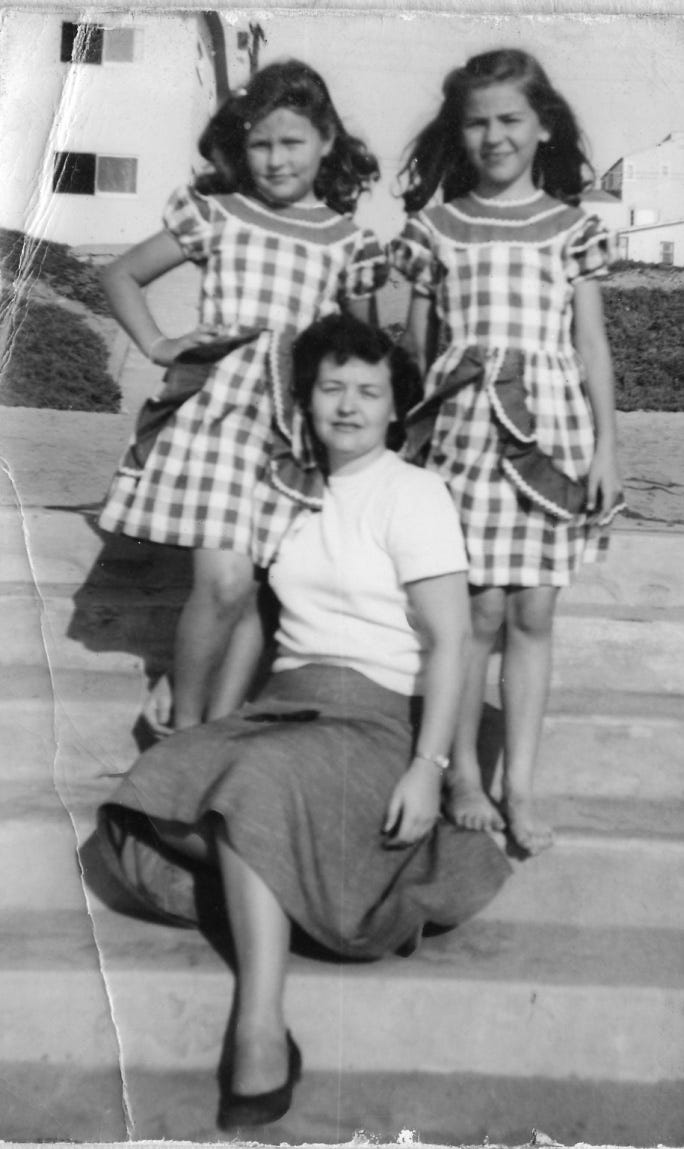
It felt like we hardly lived in Manhattan Beach. While we were a few blocks from the beach, we never swam in the ocean or fished from the famous old pier a few streets away. In fact, the only proof we lived there at all was from an old photo documenting our “day” at the beach. Judging from our matching ruffled dresses, my sister and I had come to the beach straight from church. We are in bare feet, so we must have ventured near the ocean. In the photo, Mother sits posture perfect, squinting into the sun. She’s also dressed for church in a sweater and a heavy skirt. In a nod to Rita Hayworth’s pinup pose, Mother’s equally well-turned ankles are the focus of the picture.
A California School
Grandview Elementary School was what some would call a “California school,” meaning it was progressive and possibly communist-leaning. The school’s art deco design, curves, and creamy stucco were a world apart from my boxy, brick school back in Oklahoma City. My classroom here opened onto a lush courtyard, a setting bound to encourage daydreaming.
In addition to recess, much of the morning was taken up with fruit time. While most of the kids were busy eating their healthy snacks, other students lined up in front of the class, waiting for their turn to present an open-mic version of show-and-tell. One time, I brought a pomegranate for fruit time. I had never seen one before, and it seemed an exotic choice. However, once I broke through the tough peel, I discovered the “fruit” was just a ball of seeds— hundreds and hundreds of seeds, each one covered in a sweet-tart jell. All during show and tell, I worked away at the pomegranate. I would fish out a seed, suck off the jelly, then deposit the leftover seed into a pile on my desk. Soon, I realized I was attracting my own audience. A few kids glanced over to see what I was doing, but with their curiosity satisfied, they turned their attention back to the storytellers. One or two of the kids preferred to watch me pile up pomegranate seeds. When I caught their eye, they smiled back knowingly. At first, I thought they were impressed with my seed-slurping skills, or maybe they thought I was cool. Then again, maybe they were simply being kind. (Decades later, I learned that I could eat pomegranate fruit, crunchy seeds and all.)
UP NEXT: 11: An Ill Wind